Tarun Kotia
Published in product • May 01, 2026
Feed Your Focus!
Abundance Without Clarity
We live in the most information-rich era in human history, and yet being truly informed has never felt harder.
The modern news feed was supposed to help. Instead, it became a firehose. Mainstream outlets produce content at industrial scale. Social media has minted an entirely new class of commentators, the influencers-as-reporters, delivering real-time takes around the clock. More voices, more perspectives, more access.Democratizing the megaphone is net-good for the society. But the architecture of today’s feeds doesn’t discriminate where breaking news sits next to engagement bait, genuine insight gets buried under sheer volume, and the loudest voices algorithmically crowd out the most valuable ones. You can consume news all day and still end up misinformed. A slow, creeping fatigue is setting in among the people.
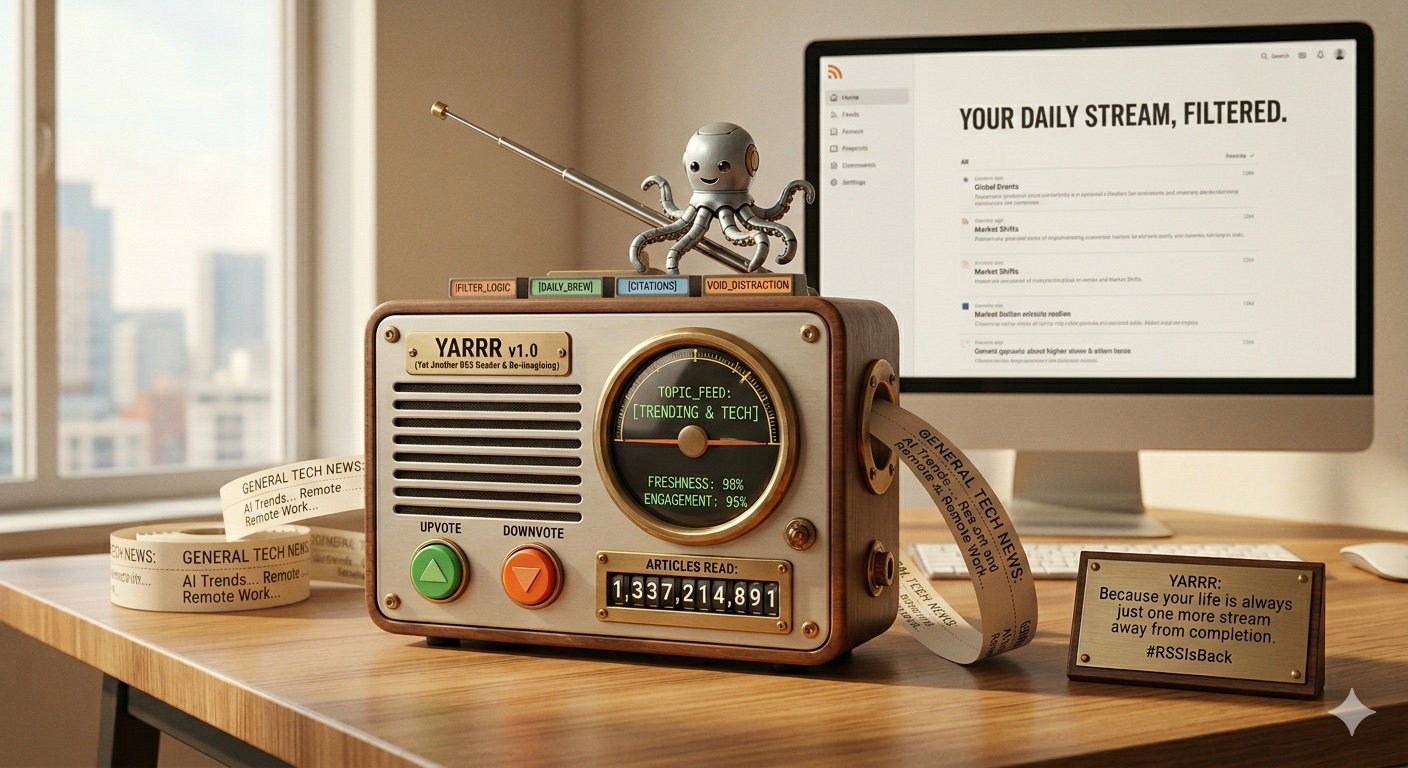 Yet Another RSS Reader, image generated using Google Gemini
If you observe RSS subreddit or Hacker News for about a week, you will see that there is a stream of new post for rss in some shape or form. To me, it looks like a symptom of dissatisfaction with the current state of affairs. This is more telling, because it reflects a hunger for something the modern feed has stopped providing: control. People want to follow what they care about, not what an algorithm has decided will keep them engaged.
But the problem runs deeper than the feed. The modern tooling on the internet today is built to provide either the synopsis or at best provide you with an inference about a topic. There are some apps like news aggregators and online magazines which try to classify articles into categories but they can be quite broad. Take artificial intelligence, Large Language Models (LLM) have sucked all the air from the room. Every day brings a new wave of articles about the latest models release, the next benchmark, the newest lab annoucement. But somewhere beneath that wave is a researcher, a practitioner, or a curious mind who couldn’t care less about LLMs, they’re focused on a narrow, important, and currently unfashionable corner of AI, computational neuroscience, perhaps, or causal inference, or neuromorhpic computing. For them, the signal they need is completely buried under an avalanche of content they didn’t ask for. The mainstream feed has no mechanism to surface what matters to them, and keyword search is too blunt an instrument to reliably find it.
Even with all the advances in LLM’s and Natural Language Processing (NLP), to do a deep dive on a topic, you require a kind of keyword gymnastics, refining searches, chasing links, second-guessing terminology and even then, you don’t know what you don’t know. It is very hard to make sense of the structure about a topic, no easy way to gauge how deep or wide the topic spans and how it evolved over time. The tooling around “Deep Research” by major AI labs are still just a longer inference without providing a sense of grip on a topic.
A Library, Not an Ocean
Next time when you are researching a topic, think about walking into a library and finding the right aisle. First thing you will notice that the shelf itself communicates something before you’ve read a single page, the number of books tells you how rich a topic is, what subdisciplines exist, where the edges are. Browsing gives you a sense of progress and proportion. You can look left and find adjacent topics, look right and find related ones, crouch down to find the foundational texts, or reach up for the more advanced material. Critically, you develop a felt sense of how much there is and therefore, of how much you still have to learn. You begin to know what you don’t know.
Digitization made retrieval blazingly fast, but it quietly killed this kind of exploration. We traded the map for a search bar.
The right design restore the maps. It treats knowledge not as a flat list of documents to be retrieved, but as a structured body of information, a living hierarchy of subjects, each with a precise identity, a location within a broader landscape, and relationships to neighboring ideas. Every topic knows its parent, its siblings, and its children. You can zoom out to see the broader field, or zoom in to find the narrow subdiscipline that nobody is writing clickbait about, but somebody somewhere is doing important work in.
The design also rethinks what it means to follow something. Today, you follow a source, a publication, an account, a channel and inherit everything it produces. The design we need inverts this, you follow a topic, and the sources come to you, filtered by relevance to that specific subject rather than by the publication’s output schedule or the algorithms’ engagement calculus.
A Canonical Topic Stream To Feed Your Focus
A canonical topic is a precisely defined, uniquely identified entity, a single, authoritative representation of a subject. Not a hashtag, not a keywork, not a loosely defined category, but a specific, stable identity for a field of knowledge. At the time of writing, we have over 630k topics indexed across 30m articles, with new ones added every day reflecting the breadth of human inquiry, from the broad and mainstream to the narrow and obscure.
Each topic sits within a navigable hierarchy. It has a parent category you can zoom out to, sibling topics you can browse laterally, and sub-topics you can drill into. The shape of a topic becomes visible. That researchers who only cares about nueromorphic computing doesn’t have to wade through a thousand LLM article to find the three that matter to them, they navigate directly to their topic, subscribe to it, and receive a stream of content precisely matched to that field. The long tail is no longer buried. It has an address.
Topic-based streaming provides content that is directly and verifiably relevant to it, drawn from across the full landscape of sources, not filtered by what’s trending, not ranked by engagement, not distorted by the gravitational pull of whatever is dominating the news cycle. A narrow field that is currently unfashionable gets the same quality of stream as the topic that everyone is writing about. Volume no longer determines visibility. Relevance does.
The experience stops feeling like a firehose and starts feeling like immersion, the kind you get when you geek out on a topic and feel your understanding building layer by layer, each piece of content finding its place in a larger picture. Want to go deeper? Navigate to a sub-topic. Want broader context? Step up to the parent. Want to explore adjacent ideas? Move laterally through the graph. The library aisle is back, rebuilt for the internet age, continously expanding, and finally capable of serving the long tail of human curiosity that the algorithm was never designed to reach.